

A lot seems to be happening very quickly. As Lois wrote last week, manufacturing crisis after crisis is a political strategy to distract, demoralize, and debilitate resistance. Empire is collapsing, authoritarian tendencies are expanding, and wealth is concentrating. Amidst the overwhelm, it can feel challenging to sustain our energy, motivation, and sense of possibility for resistance. In scattered, sometimes fleeting spaces, we can find reinforcement for our desires and creative imaginations for justice. For educators, these spaces might be our classrooms, our union halls, community organizations, or social movement spaces.
These spaces are greenhouses1 where our ideas, feelings, and desires get warmer and stronger. We learn they are actually public feelings and thoughts and we find a sense of purpose and direction in understanding that we are one part of a larger ecosystem.2
When we leave the protection and socialization of the greenhouse, the temperature of these feelings and motivations can dissipate into the harsh winter wind. Throughout the last few months, I’ve experienced, in myself and others, the general, nearly simultaneous affects of apocalyptic end times alongside the drudgery of being in the middle of life. Amidst all the ways our lives under capitalism have intensified work (waged and unwaged), most of us (I use “us” loosely but I am generally thinking of education workers), find it challenging to experience consistent, meaningful social reinforcement of credible, empirical truths that make concrete connections between our everyday experiences and the worlds we wish could be.3 In a media terrain, social and otherwise, that is largely moderated by gargantuan corporate and billionaire interests, it feels rare to read analyses that appropriately communicate what is happening, really, and what we can do (and are doing) about it.
Social Movement Unions as Greenhouses
Within K12 and higher education, social movements/social movement unionism have been a crucial source of expanding the greenhouse and heating up resistance. And, because the Right understands this, teachers unions have become politically targeted in more intense, more blatant ways than ever before. One of the most prominent examples is the Caucus of Rank-and-File Educators (CORE)-led Chicago Teachers Union (CTU). Adam Sanchez, in a recent piece for Rethinking Schools, writes that through commitment to union democracy and social justice, the CTU has become a “force field to protect against Trump’s attacks on public education” (citing CTU vice president, Jackson Potter). In their 2025 contract fight, CTU expanded protections for academic freedom, immigrant students, and LGBTQ+ students and staff alongside many other improvements to working/learning conditions. CTU is perhaps a force field to protect “against” because it is a greenhouse. It nurtures and protects the social movement energies and participation of its rank-and-file members and their wider school communities by “organizing members to solve issues at their schools and mobilizing for broader struggles” alongside democratic union practices like open bargaining.
As Lois writes, major urban unions like CTU and the United Teachers of Los Angeles are targeted most vehemently on the Right for their investment in related movements for immigrant rights, decarceration, and more. CORE grew and expanded from a much smaller social movement greenhouse back in 2008, as former CTU president and prolific leader (may she rest in power), Karen Lewis recalled: “With the ongoing wars in Iraq and Afghanistan, there was a strong antiwar movement by teachers, parents, and community members, who fought back against the plan [that would allow the military to take over Senn High School]. Jesse [Sharkey, social studies teacher,] was a leader in that. Ultimately, the board of education put the program in, but Jesse’s willingness and ability to fight made me want to do better work in organizing my building” (my emphasis).
Now the CTU operates as a larger greenhouse in which Chicago education workers, and even those of us in other places who find inspiration in their successes, have more and better social reinforcement that education unions can shape more humane, even visionary, educational policy and practice. They are creating cracks and fissures in the policy program of everything for a tiny few, fear and immiseration for the rest.
What Weakens Our Greenhouse Spaces?
Like the most transformative, democratic classroom spaces, greenhouses are microcosms of social and political life, where engaging seriously with diverse perspectives and experiences is crucial for deepening collective sense-making of social problems.
In the red state walkouts in 2018, demands were mainly focused on economics (wages, health insurance and retirement benefits, and overall public education funding restoration) and did not, to the same extent, formally address intersecting social issues that also shape the conditions of teaching and learning in schools. However, it’s important to understand just how much these mobilizations were made possible by organizers who were also embedded within local social movement and democratic union reform efforts – these folks are not often appropriately credited for their roles in producing the greenhouse effects that influenced teacher movements across the nation.
In Lois’s post last week, she writes that the red state walkouts “launched a vast social movement, developing and bringing with them new allies, in some of the most conservative regions of this country, aided by radical ideas and activists. ... And we learned with and from them that ‘when these social movements are at flood tide …multitudes of ordinary men and women glimpse a world transformed.’" This is true!
At the same time, a lot of the energy and mobilization in the years following the walkouts, especially in states like mine without strong labor union cultures and infrastructures4, were sucked back out of the greenhouse and subsumed into lobbying, political endorsements, and state legislative election campaigns5. Many social movement-embedded organizers who undertook much of the greenhouse building work were pushed to the side by other leaders, often with good intentions, who feared losing wider support. Tensions within these labor movements to narrow or ignore how racism, settlerism, and gender and sexual discrimination intersect with school economics and shape teachers’ working conditions and students’ learning conditions in the name of unity actually hindered momentum in the red state walkouts.
For example, In Kentucky, the statewide sickouts in 2018, many leaders of the actions were also active in movements for Black lives as teachers in Jefferson County, where Louisville is located, the most populous racially diverse city in the state. Jefferson County teachers and union leaders who had long been working toward union reform and a focus on racial justice in their union organized a robust turnout during their first statewide sickout in spring 2018. In their chapter in Givan’s and Lang’s (2020) Strike for the Common Good: Fighting for the Future of Public Education, Tia Edison and Ivonne Rovira detail in more in-depth that they engaged with Black Lives Matter local movement organizations in the Red for Ed movement to oppose a proposed bill that would legalize racial profiling and harm Louisville’s Black students and families and strengthen the school-to-prison nexus. Some named it the “Youth Incarceration Bill”.
In connecting these struggles for real state investment in Louisville’s youth, they created a greenhouse effect that galvanized Jefferson County teachers, students and families, and community. However, some statewide leaders feared that naming state-sanctioned racism as an education issue would turn away rural supporters and divide the movement. Many Jefferson County teacher organizers were muted or blocked from the larger statewide coordinating platforms. This lockdown response is what really created major divisions in the movement, and the second statewide sickout that year lacked the same momentum and community support from the most populous part of the state, Jefferson County.
More recently, at the National Education Association’s (NEA’s) 2025 Representatives Assembly, the majority of the union’s 7,000 delegates passed a motion that originated in the Educators for Palestine caucus, which reads:
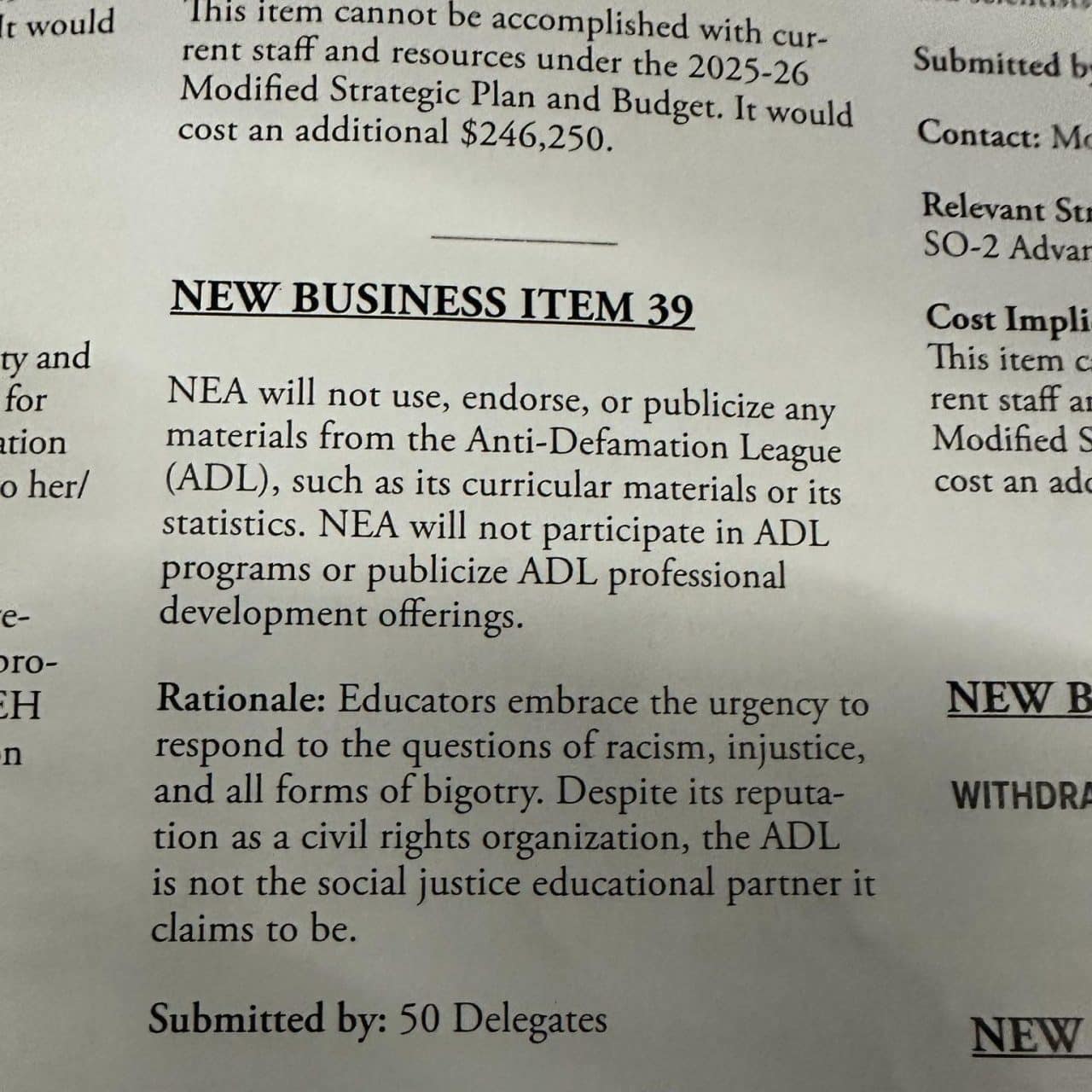
NEA will not use, endorse, or publicize any materials from the Anti-Defamation League (ADL), such as its curricular materials or statistics. NEA will not participate in ADL programs or publicize ADL professional development offerings. Rationale: Educators embrace the urgency to respond to the questions of racism, injustice, and all forms of bigotry. Despite its reputation as a civil rights organization, the ADL is not the social justice educational partner it claims to be.
The Educators for Palestine caucus created a greenhouse moment in which educators reinforced one another’s understanding that teachers’ work is connected to the ways in which consent is manufactured for U.S. involvement in Israel’s violent occupation of Palestine. Despite its democratic passage, the motion was ultimately rejected by the NEA’s executive board (possibly in violation of NEA standing rules). NEA president, Becky Pringle, wrote in a statement that “After consideration, it was determined that this proposal would not further NEA’s commitment to academic freedom, our membership, or our goals. Today’s vote by the NEA Board of Directors to not adopt this proposal completes NEA’s process.”
Jewish scholars, Brooke Lober, Eli Meyerhoff, and Emily Schneider, write for Academe in response to the use of claims of the prevalence of antisemitism to bludgeon student-led protests and hijack higher education, “Instead of telling a nuanced, responsible story about all that has happened, the Trump administration and the far right, like the Democratic administration that preceded them, have spread the reductive story that the campus tensions are caused by antisemitism. … It’s time to call out the big lie for what it is: an effort to silence dissent and smear protesters.” Their analysis and stance, supported by empirical evidence, is like a breath of warm, oxygen-rich air. On the other hand, the NEA executive board’s capitulation to the ADL and other organizations invested in the U.S.’s continued support for genocide contributes to the temperature-dropping political strategy of demoralization.
Heating Up Our Movements
Greenhouses are social movement spaces that connect the conditions education workers are experiencing on the ground to their actual sources and then work to address these, even if it challenges their assumptions about what counts as an education issue. They are places where folks can seriously engage in asking and making sense of questions, like those posed by Keith and Chloe in their recent posts for our collective. In my examples above, I also tried to demonstrate that education workers who are most grounded in these conditions (like Jesse, Karen, Tia, Ivonne, Jefferson County teachers and community-based organizations, Educators for Palestine caucus members, and so on) are often the ones who are doing the most to construct these greenhouse spaces in the first place. When education workers engage with questions about how their own working conditions are students’ learning conditions, and, in turn, are also their communities’ social, economic, and political life conditions, the greenhouse effect intensifies.
As Chloe documents in her dissertation study of the Movement of Rank-and-File Educators (MORE) in New York and the Caucus of Working Educations (WE) in Philadelphia, and as Brendan Muckian-Bates and I recount in our study of the red state walkouts6, these tensions between social justice, union democracy, and mobilization of union members across different political sensibilities are common in most, if not all, education unions.
Ignoring or avoiding these tensions does not unify or strengthen the movement, it kicks us all back out into the harsh winter wind.
Credit to my friend and metro Detroit-based public sociologist, October Krausch, for coming up with the metaphor of the greenhouse in a recent conversation during our weekly feminist writing group. I loved their phrasing of the “harsh winter wind” outside the greenhouse. Their principled commitment to the struggle and friendship serve as an important greenhouse space for me. You can read more about their work here: https://octoberk.com/
This piece by Mark Stern and Amy Brown excellently describes this (message if you want to access): Stern, M., Brown, A. “It’s 5:30. I’m exhausted. And I have to go all the way to f*%#ing Fishtown.”: Educator Depression, Activism, and Finding (Armed) Love in a Hopeless (Neoliberal) Place. Urban Rev 48, 333–354 (2016). https://doi.org/10.1007/s11256-016-0357-x
Leah’s post on somatic abolitionism provides important resources for understanding how organizing/activism is both an internal, embodied practice as well as a social, collective undertaking.
Lois recounts West Virginia educators’ success in creating a merger from below, which had long been a goal of many union reform organizers prior to their strikes in 2018 and 2019. It’s also important to understand how the strikes originated in the southern coal counties, places that have been shaped by some of the bloodiest union battles in U.S. history. West Virginia continues to have a strong labor culture. Brendan recounts in Chapter 4 and the epilogue of our book how, following the strikes, their WV United caucus explicitly avoided involvement in electoral politics, choosing to continue to focus on building and organizing rank-and-file members.
Noah Karvelis, who was an Arizona Educators United organizer during the walkouts, writes about this in more depth in the context of Arizona.
All of us in the Future of Our Schools Collective engage these ideas in various ways in our writing. See Leah’s article in the context of the NEW caucus in Newark, NJ. Keith’s book undertakes this greenhouse-expanding work documenting the hopes and politics of Camden, NJ residents in response to predatory urban reform projects. Lois’ corpus of work has long asked us to understand how teachers unions can intervene in capitalism as a social system.
The idea of "greenhouses" is so valuable - and inspiring. There's no separating social justice from building and sustaining powerful labor struggles, and education workers can show why.